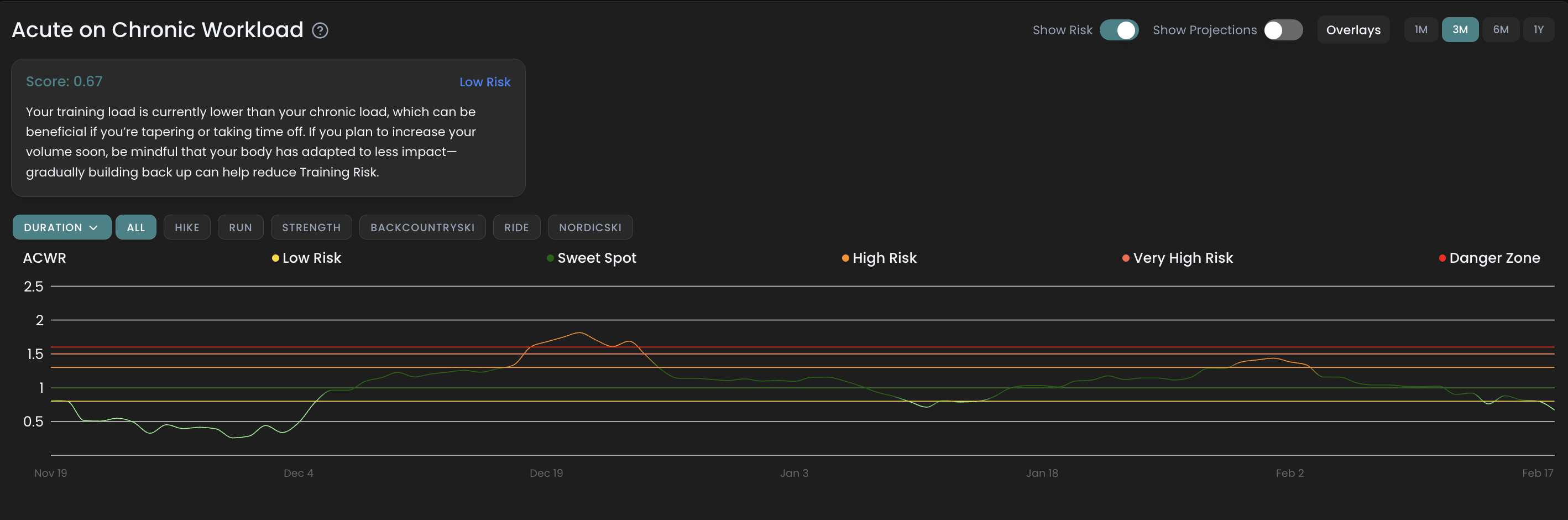
What is the acute:chronic workload ratio?
The acute:chronic workload ratio (ACWR) compares how much an athlete trained this week with how much they have been training over the last month. Acute load is what the body is dealing with right now. Chronic load is the fitness the athlete has built up to handle it.
When acute load climbs far above chronic load, the athlete is doing more than their body is prepared for. That gap is what ACWR measures, and it is one of the simplest ways to catch a dangerous jump in training before it turns into an injury.
How to calculate ACWR
Say an athlete's last four weeks were 1,200, 1,300, 1,250 and 1,500 units. The four-week average is about 1,313, so this week's ACWR is 1,500 ÷ 1,313 = 1.14. That sits comfortably in the sweet spot.
Any measure of load works as long as you stay consistent. Session RPE (minutes x perceived effort on a 1 to 10 scale) is the most popular because it works for running, lifting, team sports and rehab alike.
ACWR zones and what they mean
| ACWR | Zone | What to do |
|---|---|---|
| Below 0.8 | Undertraining | Build back gradually so the return to normal load is not a spike. |
| 0.8 to 1.3 | Sweet spot | Keep progressing. This is where adaptation happens with the lowest risk. |
| 1.3 to 1.5 | Caution | Hold load steady and watch recovery, soreness and pain. |
| Above 1.5 | High risk | Pull back. Spikes this size are linked to more injuries. |
These zones come from research on team sport athletes (Gabbett, British Journal of Sports Medicine, 2016), which found injury risk rose sharply once ACWR passed about 1.5.
Coupled vs uncoupled ACWR
The coupled method includes this week in the four-week chronic average. It is the original approach and the one most coaches know.
The uncoupled method uses only the three weeks before this one. Researchers (Lolli and colleagues, 2019) pointed out that coupling creates a mathematical link between the two numbers, so uncoupled ratios react more to spikes. Either is fine for day to day coaching. What matters is using the same method every week.
What ACWR does not tell you
ACWR is a load signal, not a diagnosis. It cannot see a poor night's sleep, a stressful exam week, a niggle in an Achilles, or an athlete coming back from injury with a low chronic base. Researchers have also questioned how well it predicts injury on its own (Impellizzeri and colleagues, 2020).
In our physical therapy clinic, we use ACWR as a conversation starter. A high ratio paired with rising pain or poor recovery scores is a reason to act. A high ratio in an athlete who feels great is a reason to watch closely. That is why SteadyState puts load, recovery check-ins and pain tracking side by side.