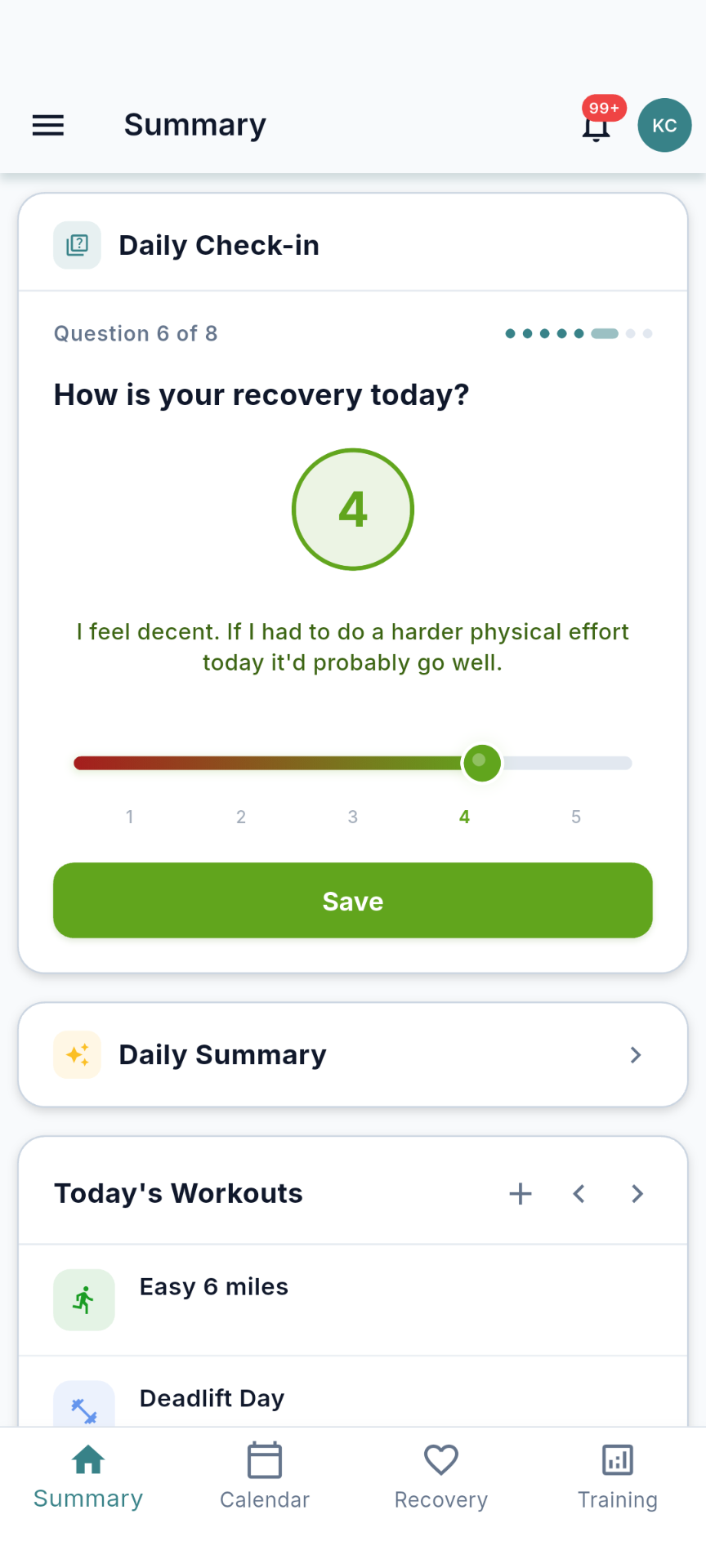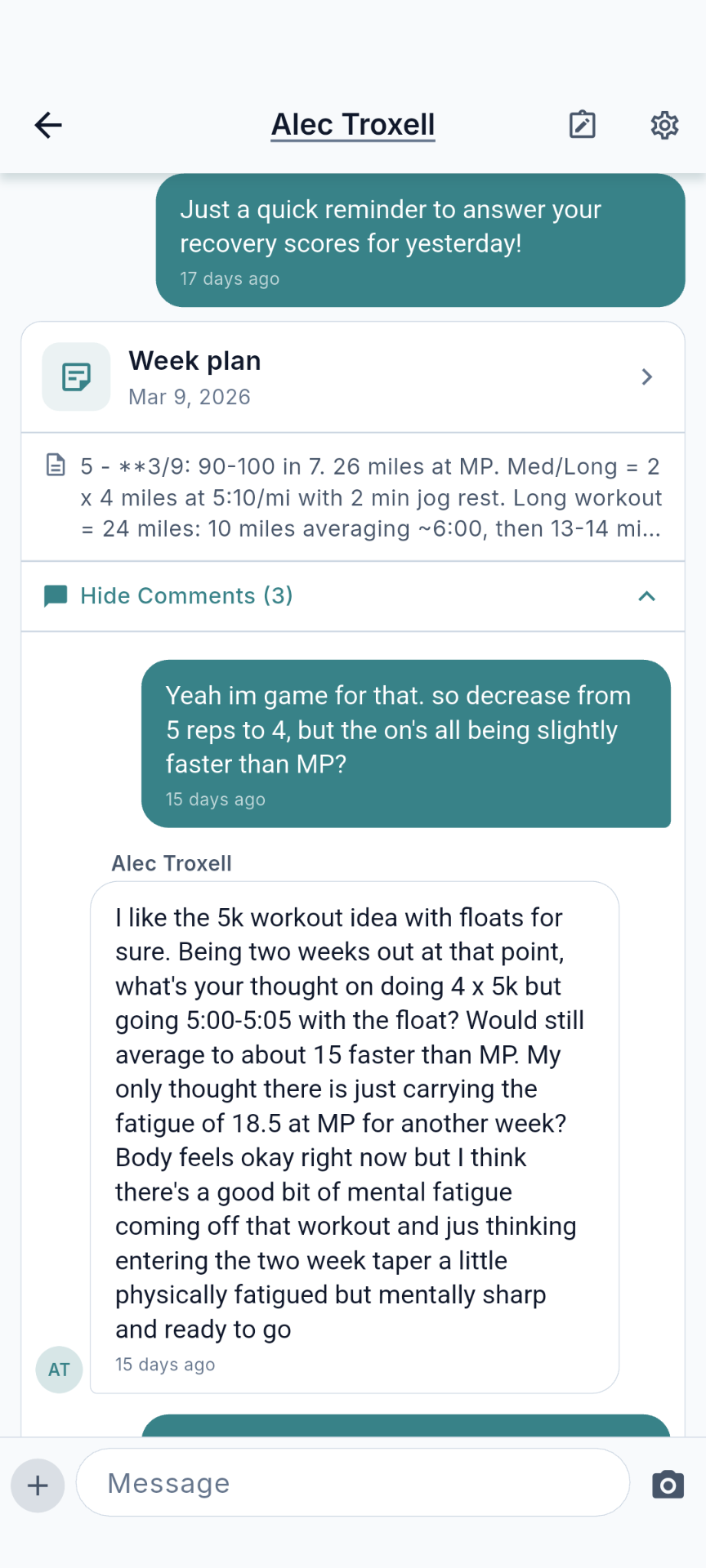
Most athletes do not tell their coach when something is off. Some do not want to overreact, some do not want to be a burden, and some assume what they are feeling is normal. By the time they say something, the problem has usually been building for a week or two.
A short daily wellness questionnaire closes that gap. It takes athletes less than a minute, and it gives you a running record of how they are actually responding to training.
Key takeaways
- Subjective measures like sleep, fatigue, soreness and stress track training stress at least as well as many objective measures (Saw and colleagues, 2016).
- Keep it short: four to six questions, answered at the same time each day.
- Compare each athlete with their own normal, not with the team.
- One bad day is a conversation. Several in a row is a reason to adjust training.
Why subjective questions work
It is tempting to think heart rate variability or a lab test would be more reliable than asking someone how they slept. But a large review of athlete monitoring research found that simple self-reported measures responded to changes in training load more consistently than common objective markers (Saw and colleagues, British Journal of Sports Medicine, 2016).
That makes sense. An athlete's sense of fatigue reflects training, sleep, work stress, nutrition and illness all at once. No single sensor sees all of that.
What to ask
The most widely used format is based on the Hooper index, which rates four items on a 1 to 7 scale, where 1 is very, very good and 7 is very, very bad.
| Question | Scale | Why it matters |
|---|---|---|
| How well did you sleep? | 1 to 7 | Poor sleep reduces recovery and raises injury and illness risk |
| How stressed are you? | 1 to 7 | Life stress adds to training stress |
| How fatigued are you? | 1 to 7 | The most direct read on accumulated load |
| How sore are your muscles? | 1 to 7 | Rising soreness can signal a load spike |
| Any pain? Where and how bad? | 0 to 10 | Separates normal soreness from a developing injury |
Add the four 1 to 7 items for a wellness score from 4 (great) to 28 (awful). Keep pain separate, since a single painful spot matters more than a slightly higher total.
Depending on your athletes, you might add one custom question, such as menstrual cycle symptoms, fueling, or mood. Resist adding more. Every extra question lowers the chance athletes keep answering.
How to read the results
The most useful comparison is each athlete against their own recent average. Some athletes always rate their sleep a 4. Others are a 2 on a normal day. A jump from 2 to 5 means far more than a steady 4.
- Watch for drops from an athlete's normal. A wellness score 20% or more worse than their 7-day average is a useful flag.
- Take pain seriously. Pain of 4 out of 10 or more, or pain in the same spot for several days, deserves a conversation.
- Look for patterns, not single days. One rough night is life. Three in a row during a hard block is a signal.
- Pair it with training load. Rising fatigue during a planned build is expected. Rising fatigue during an easy week is not.
Change the conversation
Instead of asking "how are you feeling?", you can ask "your sleep scores have dropped this week, what is going on?" That is a far more productive place to start.
Getting athletes to actually fill it in
- Make it fast. Under a minute, on their phone, at the same time each day.
- Close the loop. If athletes never hear about their answers, they stop answering. Respond to flags, even briefly.
- Explain the why. Tell them it helps you adjust training before small problems become injuries.
- Never punish honesty. If a bad score always means a hard conversation, scores will mysteriously improve.
References
- Saw AE, Main LC, Gastin PB. Monitoring the athlete training response: subjective self-reported measures trump commonly used objective measures. Br J Sports Med. 2016.
- Hooper SL, Mackinnon LT. Monitoring overtraining in athletes. Sports Med. 1995.

Dr. Kelton Cullenberg, PT, DPT
Kelton is a running physical therapist and coach in Portland, Maine. He has helped runners from beginners to Olympians rehab injuries and train smarter, and ran Division I cross country at the University of Maine.
This guide is educational and not a substitute for an assessment by a licensed clinician.