In our clinic, a client might spend one hour a week with us and the other 167 hours training, sleeping, working and making their own decisions about their rehab. Most of what determines their outcome happens in that time.
Yet most clinics only learn what happened between visits from a quick recap at the start of the next session. Here is how we approach between-visit monitoring, and how to set it up without burying yourself in admin.
Key takeaways
- Track a small set of markers: pain, training load, recovery and adherence.
- Recorded together, they show how a client is responding to the plan, not just whether they did it.
- Use simple rules to decide when to reach out, so you only spend time where it matters.
- Start with a handful of clients on longer plans of care before rolling it out clinic-wide.
What goes wrong between visits
The problems that stall progress rarely appear during an appointment. They develop slowly in between:
- Adherence quietly drops off after the first couple of weeks
- Clients increase training without telling you, often right after they start to feel better
- They are unsure whether pain during activity means they should stop
- Poor sleep or a stressful stretch at work slows recovery
- They gradually disengage from the process
By the next visit, you are reconstructing a week or two from memory, and some of those details are already the difference between progress and a setback.
What to track
| Marker | How | What it tells you |
|---|---|---|
| Pain | 0 to 10 during activity and the next morning | Whether the current load is tolerable |
| Training load | Synced from a watch or Strava, or logged time and effort | Whether activity is changing faster than planned |
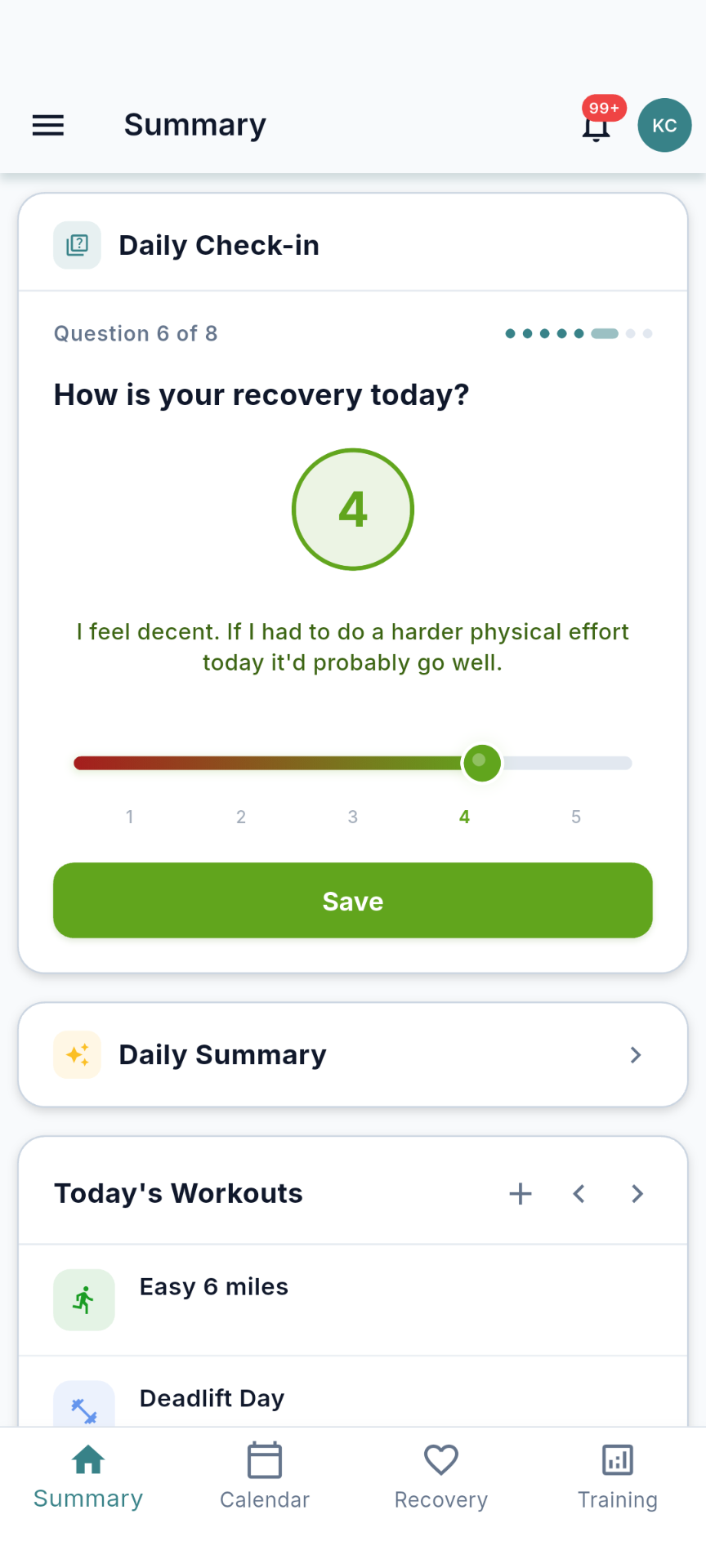
| Recovery | Daily sleep, fatigue, soreness and stress | Capacity to handle load this week |
| Adherence | Prescribed exercises completed | Whether the plan is actually being done |
Any one of these alone is limited. Pain without load data cannot tell you whether symptoms flared because of the exercises or because the client ran twice as far as usual. Together, they show what the client is responding to.
Decide in advance when to reach out
Monitoring only saves time if you are not reviewing every data point. Set a few simple triggers and spend your attention there.
- Pain of 5 out of 10 or more, or pain the next morning that is worse than baseline
- A training week well above the client's recent average (an ACWR above about 1.5)
- Two or three days of poor recovery scores in a row
- No exercises logged for several days
A short message when one of these triggers is often enough. "I saw your Achilles was a 6 after Tuesday's run. What did that session look like?" keeps you involved without scheduling another visit.
Getting clients on board
Not every client will be excited about an app. Adoption improves when you connect it directly to their care. A framing that works for us:
"Between sessions we keep track of how your training, recovery and symptoms are responding. It helps us make better decisions about your rehab and when to progress."
Keep the daily ask short, and respond when clients log something concerning. Clients who see that their entries lead to real adjustments keep logging.
Start small
You do not need to change how your whole clinic works at once. Start with five to ten clients who are on longer plans of care that blend rehab and return to training. They benefit most, and you will learn which triggers and check-ins are worth your time before expanding.
References
- Silbernagel KG, et al. Continued sports activity, using a pain-monitoring model, during rehabilitation in patients with Achilles tendinopathy. Am J Sports Med. 2007.
- Saw AE, Main LC, Gastin PB. Monitoring the athlete training response: subjective self-reported measures trump commonly used objective measures. Br J Sports Med. 2016.

Dr. Kelton Cullenberg, PT, DPT
Kelton is a running physical therapist and coach in Portland, Maine. He has helped runners from beginners to Olympians rehab injuries and train smarter, and ran Division I cross country at the University of Maine.
This guide is educational and not a substitute for an assessment by a licensed clinician.