Coming back from an injury is where a lot of runners get hurt again. You feel good, you have lost fitness you want back, and your old routine feels normal. But your tissues have lost some of their tolerance, and jumping straight back to your old mileage is one of the biggest load spikes you can give your body.
This is the general framework we use in our clinic. It is not a substitute for advice from your own clinician, especially after a bone stress injury or surgery, but it will help you understand what a sensible return looks like.
Key takeaways
- Pass a few simple readiness tests before your first run back.
- Start with walk-run intervals and progress only when the previous step felt fine during the run and the next morning.
- Mild pain (up to about 2 to 3 out of 10) that settles by the next morning is usually acceptable. Pain that builds during a run or lingers is not.
- Rebuild strength alongside running, not instead of it.
Are you ready for your first run?
Before your first run back, you should be able to do these without pain above about 2 out of 10:
- Walk briskly for 30 minutes
- Do 10 single-leg squats on the injured side with good control
- Do 20 single-leg calf raises on the injured side
- Hop on the injured leg 10 to 20 times
- Jog on the spot for about a minute
If any of these hurt, that is useful information. It usually means you need more strength work or more time before running, not that you need to push through.
A sample walk-run progression
Run every other day at an easy, conversational pace on flat ground. Only move to the next stage when the current one felt fine during the run and the next morning. If a stage causes problems, drop back one.
| Stage | Intervals | Total time |
|---|---|---|
| 1 | Run 1 min, walk 2 min, repeat 6 times | 18 min |
| 2 | Run 2 min, walk 2 min, repeat 5 times | 20 min |
| 3 | Run 3 min, walk 1 min, repeat 5 times | 20 min |
| 4 | Run 5 min, walk 1 min, repeat 4 times | 24 min |
| 5 | Run 8 min, walk 1 min, repeat 3 times | 27 min |
| 6 | Run 20 to 30 min continuously | 20 to 30 min |
Most runners take three to six weeks to get through this, depending on the injury and how long they were off. After continuous running feels easy, rebuild weekly volume gradually. Our guide on how much to increase mileage covers that next phase.
Pain rules for your comeback
Some discomfort is normal when you load a healing tissue. The goal is not zero pain, it is pain that stays mild and settles quickly. Research on tendon rehab supports this kind of pain-monitored approach (Silbernagel and colleagues, 2007).
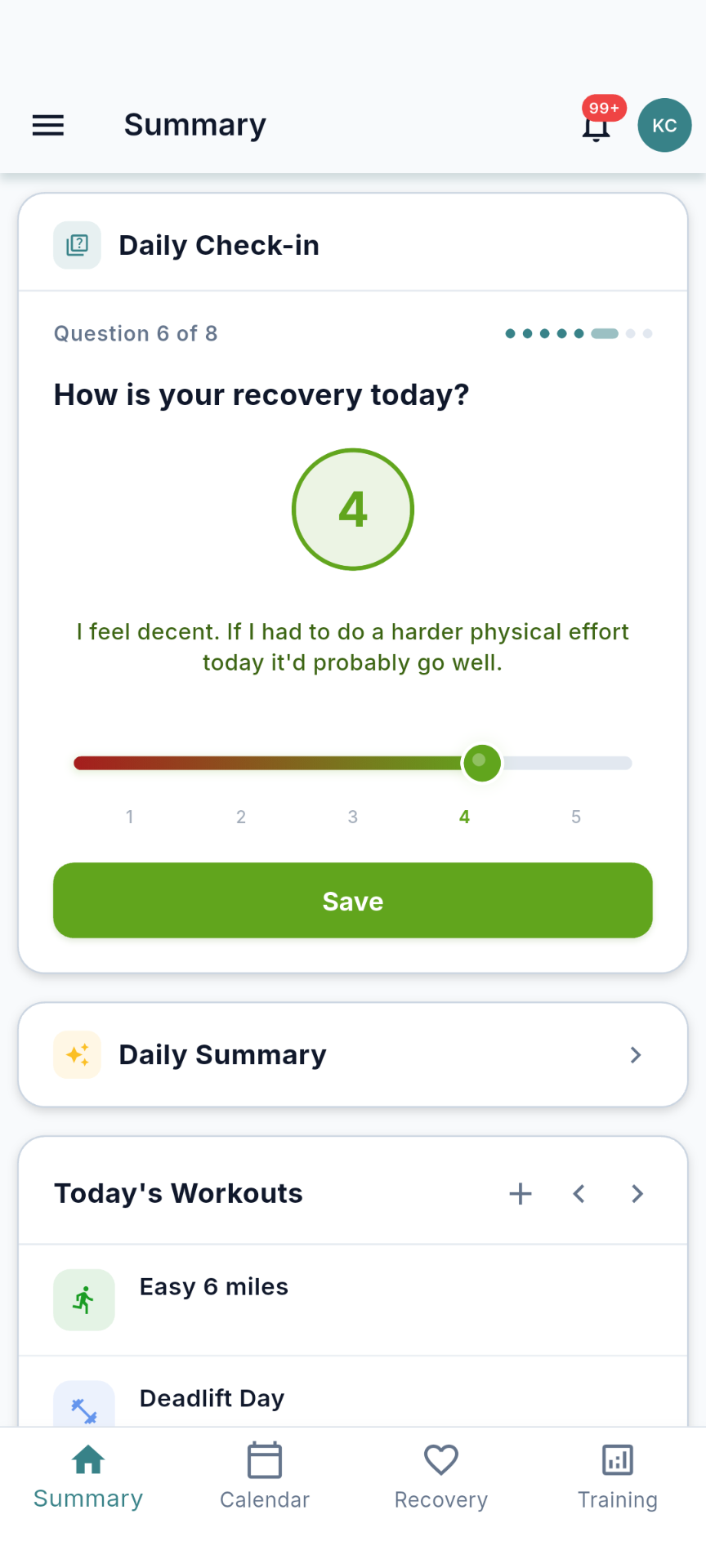
- During the run: pain up to about 2 to 3 out of 10 that stays level is generally fine. Stop if it climbs or changes how you run.
- The next morning: pain and stiffness should be back to your usual baseline. If it is worse, repeat the previous stage.
- Across the week: symptoms should trend down or stay flat, not slowly creep up.
Write it down
Memory is unreliable. Logging pain after each run and again the next morning makes it obvious whether you are improving, and gives your PT or coach real data to work with.
Do not skip strength work
Running alone is often not enough to rebuild the capacity you lost. Keep doing your rehab exercises two to three times a week through the whole return, especially calf, hip and quad strength. On run days, do strength after the run or later in the day.
When to see a professional
- Pain that gets worse as you run, or makes you limp
- Pain at night or at rest
- Pinpoint bone pain, especially in the shin, foot or hip, which can signal a bone stress injury
- You keep stalling at the same stage
References
- Silbernagel KG, et al. Continued sports activity, using a pain-monitoring model, during rehabilitation in patients with Achilles tendinopathy. Am J Sports Med. 2007.
- Warden SJ, et al. Management and prevention of bone stress injuries in long-distance runners. J Orthop Sports Phys Ther. 2014.

Dr. Kelton Cullenberg, PT, DPT
Kelton is a running physical therapist and coach in Portland, Maine. He has helped runners from beginners to Olympians rehab injuries and train smarter, and ran Division I cross country at the University of Maine.
This guide is educational and not a substitute for an assessment by a licensed clinician.