Most running injuries we see in the clinic are not caused by a single bad run. They come from doing a little too much, a little too soon, for a few weeks in a row. Bone stress injuries, Achilles and plantar fascia pain, and runner's knee usually show up after a jump in training that felt fine at the time.
So how fast can you safely build? The short answer is that there is no single percentage that works for everyone. The better question is how this week compares with what your body is used to.
Key takeaways
- The 10% rule is a reasonable starting point, but it is too slow for low-mileage runners and can be too fast for high-mileage ones.
- Compare this week with your last four weeks, not just last week. That is what the acute:chronic workload ratio does.
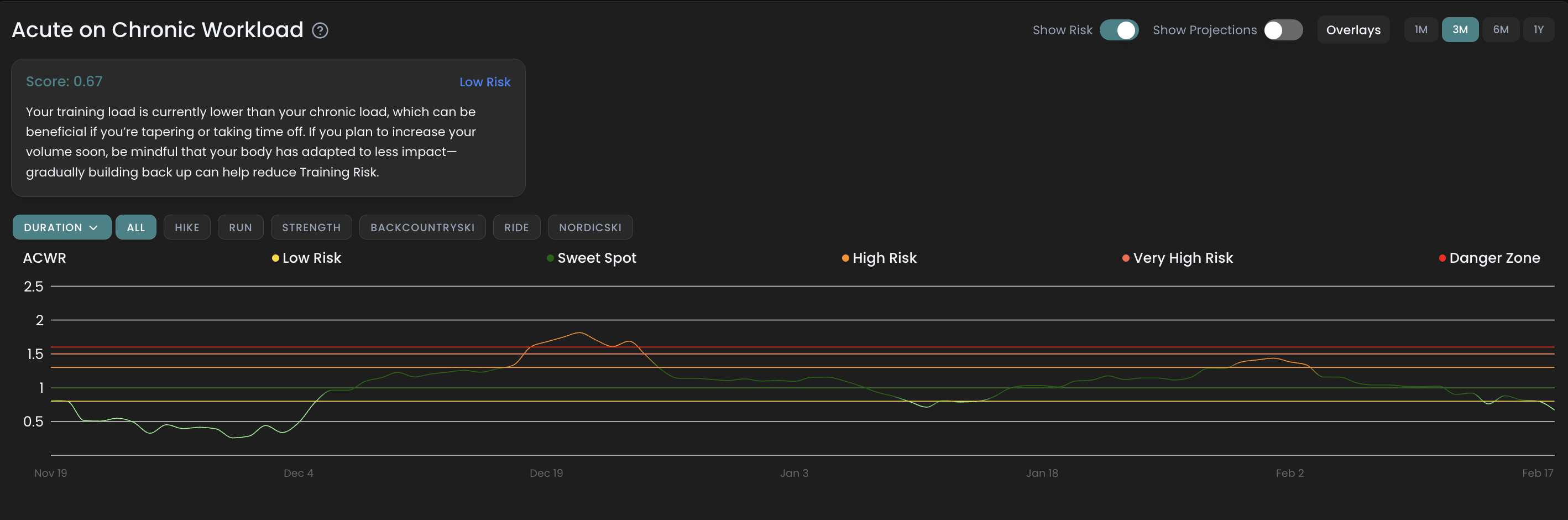
- Keeping that ratio roughly between 0.8 and 1.3 is a practical target. Above 1.5 is a spike worth avoiding.
- Build for two or three weeks, then take a lighter week. Pain that changes how you run is a reason to stop building.
Where the 10% rule comes from, and where it falls short
The 10% rule says you should not increase weekly mileage by more than 10% from one week to the next. It is simple and easy to remember, which is why it has stuck around for decades.
The problem is that it treats every runner the same. If you run 10 miles a week, 10% is just one extra mile, and it would take months to train for a half marathon. If you run 70 miles a week, adding 7 miles every week for a month is a big jump in stress on your tendons and bones. Research on novice runners has also found that a strict 10% progression did not reduce injuries compared with a faster plan (Buist and colleagues, 2008).
The rule also only looks one week back. Three steady 10% increases in a row add up to a 33% jump in a month, and a single missed week followed by a return to normal looks like a huge spike.
A better way: compare this week with your last month
Your tissues adapt to what you have been doing over the past several weeks, not just the last seven days. The acute:chronic workload ratio (ACWR) captures that. It divides this week's training load by your average weekly load over the last four weeks.
| ACWR | What it means | What to do |
|---|---|---|
| Below 0.8 | Doing less than you are prepared for | Build back gradually |
| 0.8 to 1.3 | Sweet spot | Keep progressing |
| 1.3 to 1.5 | Building fast | Hold steady and watch for niggles |
| Above 1.5 | Load spike | Pull back |
For example, if your last four weeks were 25, 28, 26 and 30 miles, your four-week average is about 27 miles. Compared with that, a 33 mile week next week is a ratio of about 1.2, comfortably in range. Jumping to 40 would be nearly 1.5, a real spike.
Try it with your own numbers
Our free ACWR calculator works in miles, kilometers or hours, and tells you the safe range for next week.
Practical rules for building mileage
- Build in blocks. Increase for two or three weeks, then take a lighter week at roughly 20 to 30% less volume. This lets your tissues catch up.
- Change one thing at a time. More miles, more speed work and more hills in the same week stack up. If you add intensity, hold volume steady.
- Be careful coming back from a break. After illness, injury or a holiday, your chronic load has dropped. A return straight to your old mileage is a spike, even though it feels normal.
- Long runs count extra. Keep your long run to roughly a third of your weekly mileage or less when you are building.
- Count cross-training honestly. Bike and pool time builds fitness but loads your legs differently. Track it, but do not assume it prepares your bones and tendons for the same running volume.
When to stop building
Numbers are only half the picture. How you respond matters just as much. In the clinic, we use a simple traffic light approach to pain during a build.
- Green: mild soreness (0 to 2 out of 10) that does not change how you run and is gone by the next morning. Keep going.
- Yellow: pain of 3 to 5 out of 10, or soreness that lingers into the next day. Hold your mileage where it is for a week.
- Red: pain above 5 out of 10, pain that gets worse as you run, or pain that makes you limp. Stop building and get it looked at.
Poor sleep, high stress and low energy also make you less able to handle a jump in training. Tracking how you feel each morning, alongside your mileage, gives you an early warning that numbers alone will miss.
References
- Buist I, et al. No effect of a graded training program on the number of running-related injuries in novice runners. Am J Sports Med. 2008.
- Gabbett TJ. The training-injury prevention paradox: should athletes be training smarter and harder? Br J Sports Med. 2016.
- Nielsen RO, et al. Excessive progression in weekly running distance and risk of running-related injuries. J Orthop Sports Phys Ther. 2014.

Dr. Kelton Cullenberg, PT, DPT
Kelton is a running physical therapist and coach in Portland, Maine. He has helped runners from beginners to Olympians rehab injuries and train smarter, and ran Division I cross country at the University of Maine.
This guide is educational and not a substitute for an assessment by a licensed clinician.